
Randevu +90 324 238 83 83
7/24 Bilgi Hattı. +90 541 720 83 83


Home »
Phakic intraocular lens surgery (ICL — intraocular lens implant)
Phakic is generally performed for patients with high prescriptions who are unsuitable for laser eye surgery. It corrects high hyperopia, high myopia and astigmatism . In other words, an ICL is a permanent lens inside the eye. Phakic intraocular surgery means the natural lens remains in place and is not removed. This distinguishes it from cataract and smart lens surgery. The natural lens is retained and no tissue is removed.
ICL surgery is performed for patients aged 21–45 who use high-prescription glasses or contact lenses and want to stop using them. Patients with high myopia of 4–20 dioptres, hyperopia of 4–9 dioptres or astigmatism of 1–5 dioptres are suitable candidates for phakic intraocular lenses. These patients are generally unsuitable for laser treatment because of corneal thickness or another factor.
Phakic intraocular lenses are transparent, invisible from outside and cannot be felt like contact lenses. The eye’s natural structure is preserved, and the lens can remain inside the eye for life. It can also be removed at the patient’s request or if another problem arises.
Phakic intraocular lens surgery is also a highly effective and lasting method for patients with stable keratoconus who are unsuitable for laser treatment.
Suitable patients are generally younger adults, between 21 and 45. Phakic lenses do not correct presbyopia, the near-vision problem that begins after 40–45. Like others who develop presbyopia, patients who have undergone ICL surgery may need reading glasses after this age.
Corneal thickness is not important in phakic intraocular lens surgery in the same way as it is in laser eye surgery.
Recovery is rapid.
Compared with laser eye treatment, phakic surgery can safely and effectively correct much higher levels of hyperopia, myopia and astigmatism.
Refractive laser surgery has upper prescription limits for myopia, astigmatism and hyperopia. However, ICL surgery has much higher upper limits. Therefore, if your prescription is unsuitable for laser eye treatment, Phakic surgery may be a good alternative for you.
In particular, Phakic surgery does not depend on corneal thickness in the same way as laser eye surgery .
Recovery after these operations is fast, as with LASIK laser eye surgery.
Phakic surgery also offers the advantage that the implanted lens can be removed in the future.
Although most people will not need their lenses removed, knowing that this is possible can be reassuring.
Patients undergoing this operation also receive protection from ultraviolet (UV) light.
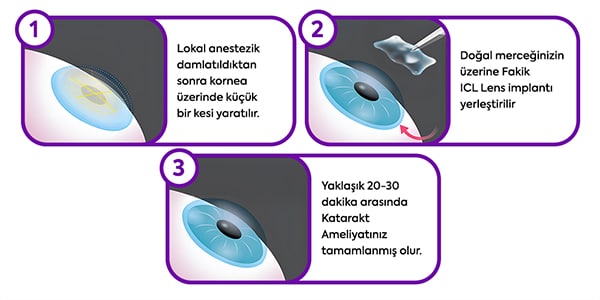
ICL surgery takes approximately 20–30 minutes per eye. Afterwards, your doctor keeps you in the recovery room for a period to ensure the artificial lens is correctly positioned and monitors your eyes closely for several hours. You can then go home. Topical eye drops are used for the period prescribed by your doctor.
ICL surgery is an outpatient procedure: you are discharged the same day and must return for a check-up the next day.
ICL surgery has a high success rate. Correct selection of suitable patients is essential. If the eye is suitable for refractive laser surgery, phakic intraocular surgery is not preferred because laser surgery is easier, more comfortable, safer and more economical for patients.
ICL surgery is more effective for treating people with higher degrees of myopia, hyperopia and astigmatism.
Phakic lensesare considered a suitable alternative for patients wishing to correct high refractive errors. However, if your eyes are suitable for refractive laser surgery, Phakic surgery is not preferred because laser eye surgery is both more comfortable and more economical for patients.
Dr. Hüseyin CENGİZ
Dr. Efsane H. CENGİZ
Dr. Ümit ATİK
Dr. Ali ÖZER
Dr. İdil GÖKSEL
Dr. Fatih BALTU
Dr. Ümit YAPICI
Click the useful links below: Who are our experienced specialist ophthalmologists?, About LASIK Eye Surgery. About the Sensitive Profile Patient Programme. About Keratoconus Cross-Linking Surgery. What are phakic ICLs? (FDA external source).
Detaylı Bilgi İçin Uzmanlarımızla Görüşün
Turgut Reis Mah. 4119 Sokak No 45/A (Çetinkaya AVM Karşısı) Akdeniz/MERSİN
.
© 2026 Özel Vizyon Göz Hastanesi
Got more questions?
Learn more from one of our experts
Turgut Reis Mah. 4119 Sokak No 45/A Akdeniz/MERSİN
e-mail: info@vizyongozhastanesi.com
© 2026 Vizyon Eye Hospital
Randevu +90 324 238 83 83