Randevu +90 324 238 83 83
7/24 Bilgi Hattı. +90 541 720 83 83


Home »
No Touch is also known as transepithelial PRK and its medical name is “Transepithelial Photorefractive Keratectomy” . In medicine, it is abbreviated to T-PRK. In this method, the corneal epithelial layer is first removed by applying intense laser pulses for an extended period. The cornea is then corrected to the required shape using an excimer laser.
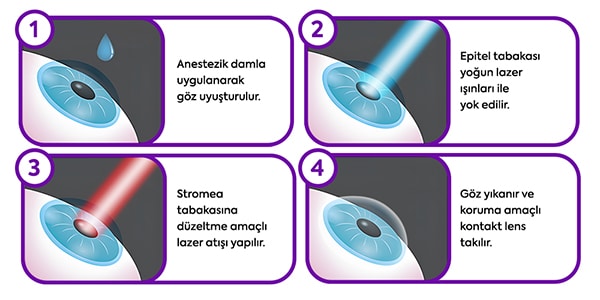
No Touch or T-PRK is generally preferred for patients with thin corneas, keratoconus problems or a history of retinal detachment. In the first stage, the epithelial layer on the surface of the cornea is removed with laser pulses applied for approximately 30 seconds. This exposes the stromal layer where the refractive error will be corrected.
In the second stage, laser pulses are applied to the stromal layer to correct the refractive error.
No Touch (T-PRK) laser eye surgery is a variation of the PRK method, which has been used since 1987. T-PRK laser eye surgery involves a long postoperative recovery period. As with other eye operations, the eye surgeon must touch the patient’s eye during No Touch (T-PRK) laser eye surgery. The doctor touching your eye during surgery does not create a medically adverse situation. On the contrary, it ensures that the required procedures are carried out fully.
is performed to treat patients with suitable eye structures who have refractive errors and keratoconus problems. These treatments are commonly known as laser vision correction . These visual defects can make daily life difficult and substantially reduce quality of life. They also make glasses or contact lenses necessary to improve quality of life, reducing patients’ everyday comfort. These requirements create unwanted inconvenience for many people.
Patients aged 18 to 40 with suitable eyes may be able to correct their visual defects using laser methods. Laser vision correction is one of the world’s most widely performed treatments for patients seeking to maximise their quality of life. Contact us 24/7 for information about this operation, which takes approximately 10–15 minutes. You can have detailed eye assessments at our hospital and quickly learn from our specialists whether you are suitable for laser eye surgery.
Dr. Hüseyin CENGİZ
Dr. Efsane H. CENGİZ
Dr. Ümit ATİK
Dr. Ali ÖZER
Dr. İdil GÖKSEL
Dr. Fatih BALTU
Dr. Ümit YAPICI
Click the useful links below: No Touch Laser Risks, Who are our ophthalmologists?, About Laser Eye Surgery, About LASIK Eye Surgery, About PRK Laser Eye Surgery, About the Sensitive Profile Patient Programme, What is laser eye surgery? (External source) About Q-LASIK Laser Eye Surgery.
Detaylı Bilgi İçin Uzmanlarımızla Görüşün
Turgut Reis Mah. 4119 Sokak No 45/A (Çetinkaya AVM Karşısı) Akdeniz/MERSİN
.
© 2026 Özel Vizyon Göz Hastanesi
Got more questions?
Learn more from one of our experts
Turgut Reis Mah. 4119 Sokak No 45/A Akdeniz/MERSİN
e-mail: info@vizyongozhastanesi.com
© 2026 Vizyon Eye Hospital
Randevu +90 324 238 83 83